
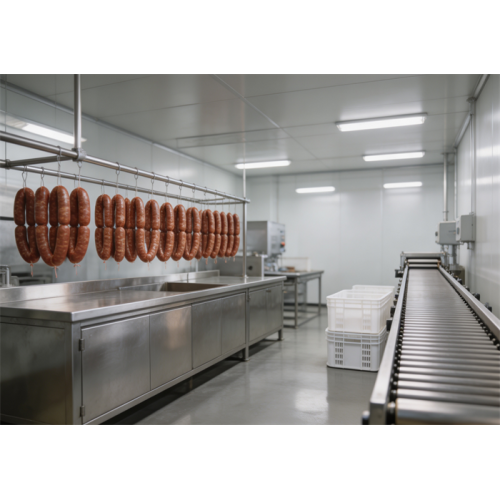
Packaging is essential when producing and selling meat products such as hams and sausages. Packaging can be divided into outer packaging and inner packaging. The main purpose of outer packaging is to isolate the product from the external environment, maintain hygiene, and allow consumers to know the product name, ingredients, weight, manufacturer, production date, etc. The main purpose of inner packaging is to prevent the product shape from being damaged during manufacturing and to standardize product specifications. The material used for inner packaging is generally referred to as casing.
I. Natural Casings
Natural casings are made from raw materials including the small intestines of pigs, cattle and sheep, as well as the large intestines, cecums and bladders of cattle. Through scraping and processing, unnecessary tissues inside and outside the intestines are removed, forming one or several layers of tough, soft, smooth, elastic, transparent or translucent films.Natural casings feature excellent toughness, elasticity, firmness, edibility, safety, water vapor permeability, smoke penetration, heat shrinkability and adhesion to meat fillings, making them an ideal natural packaging material. However, they have inconsistent specifications and shapes and limited supply, which are their disadvantages.According to the animal sources, natural casings are classified into three categories: pig casings, sheep casings and cattle casings. Based on processing methods, they are divided into two major types: salted casings and dried casings. Dried casings must be soaked in cold water to soften before stuffing; salted casings need to be rinsed repeatedly with clean water to remove salt and dirt attached to them.At present, commonly used natural casings in meat products include salted pig casings, salted sheep small casings, dried cattle casings and dried pig bladders.
II. Artificial Casings
Artificial casings are packaging materials produced by chemical synthesis. They are aesthetically pleasing, convenient to use, safe and hygienic, with fixed filling volume, easy printing, low cost, low loss and uniform specifications (facilitating standardized operations). Therefore, they are widely used in meat product manufacturing.
1.Cellulose-Based
CasingsCellulose-based casings are artificial casings made from natural cellulose such as cotton threads, wood chips, flax and other plant fibers, characterized by air permeability. They can withstand high temperatures during processing, enable rapid production, facilitate stuffing and have high crack resistance; smoking can also be performed under humid conditions. However, cellulose casings are inedible, cannot shrink with meat fillings, and must be peeled off after the finished products are made.
2.Fibrous Casings
Fibrous casings are made of specially soaked base paper coated with cellulose. They have a rough texture and are only suitable for producing smoked and dry sausage products. In Western countries, approximately 90% of hams, 25% of dry sausages and 20% of semi-dry sausages use fibrous casings.Fibrous casings have a diameter of 5–20 cm and come in colors such as red, brown and yellow, divided into peelable, cling and cut types. They feature good stability, high strength, smoke permeability, excellent meat binding ability, and can shrink with the contents.
3.Collagen Casings
Collagen casings are made from animal hides and other raw materials, with properties similar to natural casings. They are divided into edible and inedible types. Edible collagen casings can absorb a small amount of water, making them tender and soft. With uniform specifications and convenient use, they are suitable for making stuffed sausage products.
4.Plastic Casings
Plastic casings are made of polyvinylidene chloride (PVDC) and polyethylene films, and are classified into flat casings and tubular casings according to shapes. They come in various varieties and specifications, applicable to all kinds of stuffed products, but can only be cooked and cannot be smoked.Plastic casings are flexible and firm, high in strength, printable, convenient to use, available in diverse colors, and smooth and attractive. Their disadvantages include poor elasticity, non-heat resistance and inability to be perforated for exhaust. With a general diameter of 4–12 cm, they are suitable for cooked products.
5.Cellophane Casings
Cellophane casings are cellulose films that are soft in texture, good in elasticity and highly absorbent. They wrinkle when absorbing moisture in a humid state and tighten when losing moisture during drying.Cellophane casings have extremely low air permeability when dry, are impermeable to grease, high in strength and excellent in printability. Compared with natural casings, they have superior performance and low cost, making them an excellent packaging material.