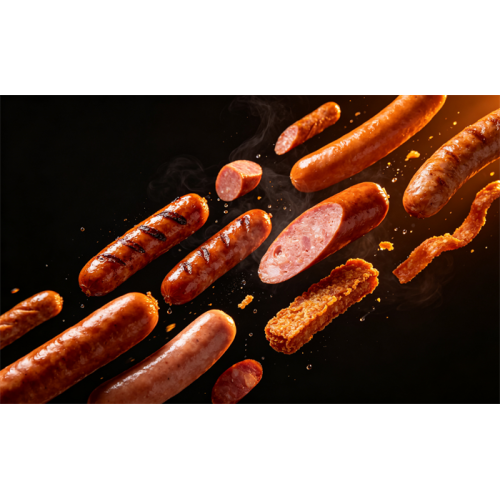
Against the backdrop of rising public health awareness, meat product consumption is undergoing a rapid shift from “satisfying satiety” to “nutrition�oriented health”. Reduced�salt, low�fat formulations and incorporation of functional ingredients have become core directions for industrial product upgrading. Thanks to its dual attributes of “nutritional fortification and processing optimization”, dietary fiber has expanded its application scope from baking and dairy sectors to meat processing. It serves as a vital functional ingredient to address insufficient health�related properties and improve processing performance of meat products.
I. Core Values of Introducing Dietary Fiber into Meat Product Processing
The application of dietary fiber in meat products goes beyond simple nutritional supplementation. It delivers benefits across three dimensions: nutritional value, processing performance and economic efficiency, representing a technical solution integrating health�oriented concepts and practical value.
1. Endowing products with health�promoting functions to meet consumption upgrading
Traditional meat products are nutritionally characterized by “high fat, high protein and low dietary fiber”. Excessive long�term intake may impose gastrointestinal burden and trigger dyslipidemia and other health concerns. Incorporation of dietary fiber can markedly enhance the physiological activity of final products:
Stimulate intestinal peristalsis and maintain intestinal microecological balance, catering to consumers’ demands for gastrointestinal health;
Certain soluble dietary fibers retard the absorption of fat and cholesterol, assisting blood�lipid regulation and aligning with the positioning of low�fat meat products;
Boost satiety and lower energy density, suitable for consumers pursuing weight management.
Furthermore, claims such as “high�fiber” or “containing dietary fiber” create differentiated selling points for enterprises, enabling them to escape price�driven competition and develop mid�to�high�end health�focused product lines.
2. Optimizing processing performance and improving product quality
Apart from nutritional merits, the physicochemical properties of dietary fiber bring substantial improvements to processing quality, which accounts for its wide acceptance by manufacturers:
Water�holding and oil�binding capacity: Hydrophilic and hydrophobic groups on dietary fiber molecules bind water and fat respectively, reducing juice loss during cooking and frying, boosting product yield, mitigating fat separation and extending shelf�life.
Textural modification: Insoluble dietary fiber enhances chewiness and structural compactness of meat products, while soluble dietary fiber elevates system viscosity and smoothness. Both improve slicing property, elasticity and mouthfeel.
Emulsion system stabilization: Soluble dietary fiber exhibits partial emulsifying activity, reinforcing the emulsion stability of meat batters and preventing fat separation. It effectively alleviates dry mouthfeel and loose texture frequently observed in low�fat meat products.
3. Optimizing cost structure and mitigating raw�material pressure
Amid price volatility of meat raw materials, appropriate addition of dietary fiber can partially replace lean meat or fat without compromising sensory attributes, thereby cutting raw�material costs. Higher product yield also indirectly reduces raw�material loss per unit finished product.
II. Processing Characteristics and Product Adaptability of Different Types of Dietary Fiber
Based on solubility, dietary fiber is classified into insoluble dietary fiber and soluble dietary fiber. Distinct physical properties lead to different suitability for meat product categories and processing scenarios.
1. Insoluble dietary fiber: Focus on texture improvement and yield enhancement
Main components include cellulose, hemicellulose and lignin. Common sources comprise wheat fiber, bamboo fiber, oat bran, peanut�shell fiber, etc.
Core characteristics: Strong water�holding capacity and porous structure; strengthen solid�state texture and chewiness of products.
Applicable products: Cured sausages, meatballs, restructured meat products and other items requiring defined textural properties.
Typical applications: Addition of wheat fiber into ordinary ham sausages and luncheon meat reduces cooking loss and improves slicing performance. Combined with transglutaminase in restructured steaks and chicken steaks, it modifies internal tissue structure and lowers the dosage of trimmings.
2. Soluble dietary fiber: Focus on fat substitution and mouthfeel refinement
Major varieties include inulin, resistant dextrin, pectin, β�glucan, konjac powder, etc. They represent core ingredients for current�day low�fat meat product R&D.
Core characteristics: Water�soluble; form viscous gels that mimic the lubricating sensation of fat; superior emulsification and stability; minimal interference with product flavor.
Applicable products: Low�fat emulsified meat products, high�grade hams, children�oriented meat products and other goods demanding delicate mouthfeel.
Typical applications: Partial replacement of animal fat with inulin in low�fat sausages maintains juiciness and lubricity while fat content decreases by over 30%. Resistant dextrin features good solubility and neutral flavor, and is widely adopted in diverse functional meat products with negligible influence on intrinsic flavor.
III. Key Technical Points for Dietary Fiber Application in Meat Product Processing
Dietary fiber cannot be simply dosed into formulations. Improper handling may result in coarse mouthfeel, flavor deterioration and uneven tissue. Technical control shall cover pretreatment, compound formulation and process parameters.
1. Pretreatment and modification: Core approach to eliminate gritty mouthfeel
Naturally extracted dietary fiber normally features coarse particle size and gritty texture, which severely impairs eating experience if added directly. Mainstream industrial pretreatment methods are as follows:
Superfine grinding: Pulverize dietary fiber to micron scale to reduce granular roughness, enlarge specific surface area and strengthen water�holding and oil�binding capacity.
Enzymatic modification: Moderate degradation by cellulase and hemicellulase adjusts the ratio of soluble to insoluble fiber, improving solubility and sensory properties.
Physical modification: Extrusion�expansion, high�pressure homogenization and other technologies disrupt compact fiber structures to upgrade functional performance.
2. Synergistic compounding: Maximize application efficacy
Single dietary fiber delivers limited benefits. Compound formulas combining dietary fiber with other ingredients are commonly adopted to achieve functional complementarity:
Dietary fiber + carrageenan / xanthan gum: Synergistically enhance water retention and emulsion stability and lower total addition dosage.
Dietary fiber + soy protein isolate / pea protein: Co�construct gel networks to improve product elasticity and hardness while boosting nutritional profiles.
Combination of soluble and insoluble dietary fiber: Balance delicate mouthfeel and structural support for broader product adaptability.
3. Process control: Balance addition level and product quality
Higher dosage does not always yield better outcomes. Addition levels shall be precisely adjusted according to product categories:
Ordinary sausage products: Addition rate generally 1%�3%, primarily for processing�performance improvement without impairing meat aroma and taste.
Low�fat functional meat products: Dosage can rise to 3%�8%, dominated by soluble fiber to simulate fat�like mouthfeel.
Regarding feeding sequence, dietary fiber is usually incorporated together with other additives during batter chopping or tumbling to guarantee uniform dispersion and avoid local agglomeration.
IV. Industrial Application Status and Future Development Trends
Domestic application of dietary fiber in the meat industry is undergoing rapid development. Leading enterprises have launched high�fiber ham sausages, low�fat sausages, dietary�fiber�fortified luncheon meat and similar products. Nevertheless, overall penetration still lags behind European and American markets.
1. Primary current�day application scenarios
Low�fat meat products: The most mature application field, addressing the industry�wide pain point of deteriorated sensory quality after fat reduction.
Quick�frozen prepared meat products: Applied in meatballs, meat patties and pre�fried meat items to raise product yield and mitigate juice loss during freeze�thaw cycles.
Snack�oriented meat products: Modify texture of jerked meat and preserved meat slices, and deliver health�claim concepts in line with the health�driven trend of meat�based snacks.
2. Prospective development trends
First, natural�source ingredients and clean�label orientation. Driven by consumer preference for natural additives, naturally�sourced dietary fiber derived from fruits, vegetables and grains will gradually replace chemically modified fiber and gain greater market share.
Second, customized modification technologies. Specially�modified dietary fiber will be developed for different meat�processing requirements to precisely match textural, flavor and stability specifications.
Third, functional compounding. Dietary fiber will be compounded with probiotics, plant sterols, minerals and other functional factors to develop high�end meat products with multi�dimensional health benefits.
Fourth, improvement of standard systems. Alongside wider adoption, specifications on content labeling, detection methodologies and nutrition�claim rules for high�fiber meat products will be formulated to facilitate industrial standardization.
The utilization of dietary fiber in meat processing epitomizes industrial upgrading driven by consumer demands. It not only infuses meat products with health�promoting attributes, but also resolves multiple quality�related bottlenecks at the processing level, serving as a cost�effective technical pathway for the health�oriented transformation of the meat sector. With advances in modification technologies and growing consumer awareness, dietary fiber will achieve large�scale deployment across more meat�product categories and become a key pillar for industrial product innovation.




 Helper Machinery Group Co., Ltd.