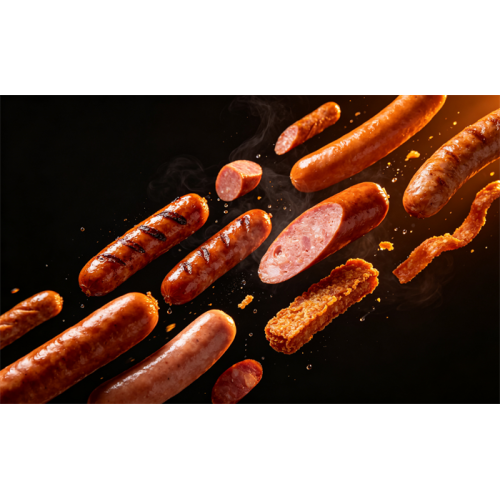
In the industrial production of sausages, drying is a core process that determines product texture, flavor, food safety and shelf life. More than 80% of product quality problems in the industry originate from inadequate control of the drying process. The essence of industrial sausage drying lies in full-process controllability, replicable parameters and traceable quality. From a professional production perspective, this paper concisely analyzes the fundamental mechanism, practical operation techniques and solutions to frequent problems in sausage drying.
1. Fundamental Mechanism of the Drying Process
In the industrial sausage production system, drying is far more than simple water removal. It is a key process integrating physical changes, chemical reactions and microbial control, and a critical link affecting the overall quality of finished products. It mainly achieves four core objectives:
Shape Setting and Texture FormationThrough gradient control of temperature and humidity, moderate denaturation of muscle protein is induced to form a stable network structure, which locks in fat and moisture. This endows sausages with a firm and elastic texture, preventing looseness and softness of finished products.
Flavor and Color StabilizationStable color development of myoglobin is achieved under controlled conditions. Meanwhile, precise temperature control promotes Maillard reaction, fat degradation and accumulation of flavor substances, forming unique fatty aroma, cured meat flavor and characteristic taste of sausages, and avoiding flavor loss caused by excessive high temperature.
Precise Control of Water ActivityThis is the bottom line of food safety in industrial production. Drying is adopted to keep the water activity (Aw) of products within a safe threshold, inhibiting the growth and reproduction of pathogenic and spoilage microorganisms. It fundamentally addresses common issues including short shelf life, package swelling and sour deterioration.
Realization of Product StandardizationPrecise temperature and humidity control via automatic equipment eliminates quality differences between batches and production stations, achieving consistent quality in large-scale production. This is the fundamental difference between industrial production and small-scale manual processing.
2. Core Techniques for the Entire Drying Process
At present, the mature and widely adopted scheme for large-scale domestic production is the three-stage drying process with gradual temperature rise and stepped humidity reduction, which is applicable to most sausage varieties. Key control requirements are as follows:
Stage 1: Preheating and Shape Setting
Core objectives: Achieve stable color development and preliminary protein setting, and prevent surface crusting.Process parameters: Temperature 50–55 ℃, relative humidity 90%–95%, air velocity 0.3–0.5 m/s, duration 2–4 hours.
Direct high-temperature drying without this preheating stage is strictly prohibited. High humidity is a prerequisite for stable color development of myoglobin. The temperature difference inside the drying chamber shall be controlled within ±1 ℃ to ensure uniform color development of all products. The priority of this stage is to balance internal and external temperature and humidity of sausage stuffing, rather than pursuing high dehydration efficiency.
Stage 2: Constant-Rate Dehydration (Main Process Stage)
Core objectives: Remove excess internal moisture at a constant rate, develop product texture and suppress microbial growth.Process parameters: Gradually raise temperature to 55–62 ℃, stepwise reduce relative humidity to 55%–75%, air velocity 0.4–0.6 m/s, duration 6–12 hours (adjustable according to product type and sausage diameter).
The golden control standard of this stage is a hourly moisture loss rate of 0.8%–1.2%. Excessively fast dehydration leads to surface crusting and internal moisture retention, while overly slow dehydration easily causes excessive microbial count. The temperature rise shall not exceed 5 ℃ per hour. For high-fat Cantonese-style sausages, the maximum temperature shall not exceed 60 ℃ to avoid rupture of fat cells and oil exudation. The moisture loss rate and central temperature of products shall be monitored every 2 hours to ensure synchronous dehydration of all products in the chamber.
Stage 3: Curing and Quality Stabilization
Core objectives: Balance internal and external moisture, concentrate flavor compounds and lower the central temperature of finished products.Process parameters: Reduce temperature to 48–52 ℃, rebound relative humidity to 60%–65%, air velocity 0.2–0.3 m/s, duration 2–4 hours.
This stage is vital for flavor improvement. It facilitates the integration and enrichment of flavor substances via Maillard reaction, preventing dry, tough texture and weak flavor of finished products. Meanwhile, it resolves defects such as hard surface and soft interior, ensuring uniform mouthfeel.
Drying Endpoint Control (Water Activity Safety Threshold)
Traditional Chinese dry sausages: Aw ≤ 0.85
Western emulsified sausages: Aw ≤ 0.90
Fermented sausages: Aw ≤ 0.82
Strict compliance with the above standards fundamentally reduces food safety risks.
3. Common Drying Problems and Practical Solutions
1. Hard surface crusting, moist interior and sour deterioration
Root cause: Initial high temperature and low humidity cause rapid denaturation of surface protein to form a dense hard layer, which blocks internal moisture migration. Residual internal moisture induces microbial reproduction and sour spoilage.
Solutions: Strictly implement the low-temperature high-humidity preheating stage, and control the hourly moisture loss rate below 1.5%. If crusting has occurred, temporarily raise relative humidity to 80%–85% to soften the hard surface layer, then conduct stepped humidity reduction and dehydration to restore internal moisture migration channels.
2. Excessive oil exudation and oxidative rancidity
Root cause: Sudden temperature rise exceeds the melting point of animal fat, resulting in massive fat cell rupture and oil separation. Insufficient emulsification of stuffing and direct hot air blowing on sausages aggravate oil loss. High temperature accelerates fat oxidation and causes rancid off-flavor in later storage.
Solutions: Limit hourly temperature rise to no more than 5 ℃, and control the maximum temperature for high-fat products below 60 ℃. Optimize stuffing emulsification process and adjust air velocity to avoid direct hot air impingement on sausages. Clean residual grease inside the drying chamber after each production shift to prevent cross-contamination from oxidation.
3. Uneven color development, obvious chromatic difference, partial whitening and graying
Root cause: Insufficient humidity in preheating stage leads to oxidative denaturation of myoglobin and abnormal color formation. Poor hot air circulation inside the drying chamber causes large local temperature differences. Uneven distribution of colorants and insufficient curing time in pickling process.
Solutions: Maintain relative humidity ≥90% in preheating stage to guarantee sufficient environment and reaction time for color development. Optimize airflow distribution in the drying chamber and control overall temperature difference within ±1 ℃. Adopt vacuum mixing equipment for uniform dispersion of auxiliary ingredients, and strictly follow low-temperature pickling duration requirements.
4. Shrinkage, deformation, bulging and cracking of sausages
Root cause: Inadequate degassing during sausage stuffing leads to trapped air bubbles expanding under heat. Overly rapid temperature rise causes uneven internal and external heating and excessive shrinkage difference. Uneven pinholes restrict smooth emission of internal water vapor.
Solutions: Use vacuum stuffing machine for sufficient degassing and adopt automatic equipment for uniform perforation. Strictly follow gradient temperature rise procedure; sudden sharp temperature increase or decrease is forbidden to avoid drastic shrinkage of sausage casings.
5. Short shelf life, package swelling and mold growth under normal temperature storage
Root cause: Substandard water activity at drying endpoint provides conditions for microbial growth. Products stay too long in the dangerous microbial temperature range (5–60 ℃), with excessive initial total bacterial count. Direct packaging of hot products causes condensation inside packaging bags.
Solutions: Strictly adhere to the water activity safety threshold at drying completion. Optimize production process to limit product retention in the dangerous microbial temperature zone to less than 4 hours. Cool products to below 25 ℃ in central temperature after drying, and complete packaging in a clean workshop.
Conclusion
The core of industrial sausage production lies not in formula, but in whole-process standardized management and control. As the decisive process for product quality, drying has no universal fixed parameters, but only scientifically refined regulation adapted to raw materials, product positioning and equipment conditions. Only by mastering the underlying principles of drying technology and establishing a fully traceable parameter control system can we fundamentally solve problems such as unstable product quality and food safety hazards, and build core product competitiveness.




 Helper Machinery Group Co., Ltd.