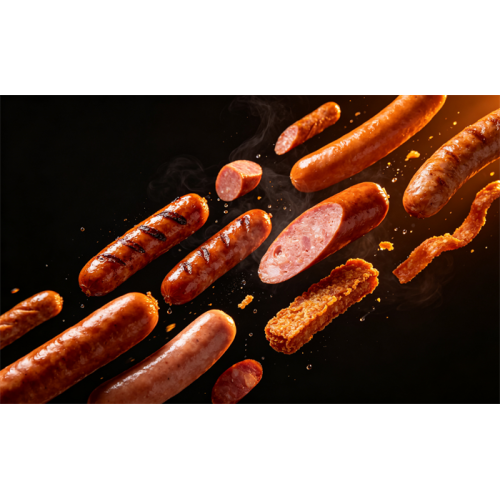
Common Quality Problems and Control in the Production of Sausage Products
2026,08,17
I. Appearance�Related Quality Problems
(I) Sausage Casing Rupture
1.Problems with sausage casings If casings suffer from varying degrees of putrefaction, the casing walls will have uneven thickness, become loose and fragile with poor rupture resistance. Salt�eroded casings shrink and lose elasticity. Sausages stuffed with such casings are prone to rupture.
2.Problems with meat batter Batter with high moisture content will expand upon rapid heating and burst the casing. Over�stuffing of meat batter and improper temperature control during cooking and baking can also cause casing rupture.
3.Process�related problems
① Uneven sausage diameter: thicker segments tend to rupture during cooking.
② Excessive fire power and over�high temperature during baking, which may even produce audible casing cracking sounds.
③ Insufficient baking time: if baking is incomplete and casing proteins are not fully coagulated before cooking, the casing cannot withstand the expansion pressure of meat batter.
④ Excessive steam supply during cooking, which causes local over�temperature and casing rupture.
⑤ Careless handling during sausage turning, leading to collision�induced cracking and breakage.
(II) Hard Surface Crust
Excessive fire intensity and high temperature during smoking, or placing the lower ends of sausages too close to the fire source, will form hard crusts at the lower parts. In severe cases, shelling occurs and causes separation between casing and meat filling. After peeling off the shelled casing, the meat filling is observed to be yellowed by over�baking.
(III) Dull Color and Poor Gloss
(1) Sausages subjected to insufficient smoking temperature, poor�quality smoke, or moisture re�absorption after smoking exhibit poor casing gloss. (2) Sausages stuffed with non�fresh meat batter also show dull casing color. (3) Smoking with high�moisture wood or softwood frequently results in blackened casings.
(IV) Uneven Color Shade
Besides differences arising from water cooking, uneven color is also related to smoking. (1) Higher smoking temperature produces lighter color; lower smoking temperature produces darker color. (2) Dry sausage surfaces yield lighter color; wet sausage surfaces dissolve smoke components in water and develop deeper color. (3) Sausages stacked and adhering to one another during smoking show pale color at contact areas.
(V) Soft and Non�Elastic Sausage Body
1.Undercooking: Such sausages are soft and inelastic. Under high�temperature conditions, they will produce acid and gas and swell, rendering them inedible.
2.Inadequate protein coagulation in muscle tissue ① Incomplete curing: myosin proteins are not fully converted from gel state to strongly adhesive sol state, impairing the water�holding capacity of meat batter. ② Insufficient chopping: incomplete release of myosin. ③ Elevated temperature during salting or processing triggers protein denaturation and destroys the colloidal state of proteins.
(VI) Absence of Surface Wrinkles
Surface wrinkles form when moisture in meat filling decreases and casings shrink during smoking. Wrinkle formation depends on sausage quality and smoking process. (1) Soft, non�elastic sausages generally develop poor surface wrinkles in finished products. (2) Larger sausage diameter and excessive moisture in meat filling also inhibit wrinkle formation. (3) Damp smoking wood leads to excessive smoke humidity and low processing temperature; insufficient smoking degree will also result in wrinkle�free finished products after smoking�baking.
II. Cross�Section�Related Quality Problems
(I) Yellow Discoloration on Cross�Section
(1) Distinguish between immediate yellowing upon cutting and gradual yellowing after cutting. If the freshly�cut cross�section shows uniform rose�red color and gradually fades to yellow upon exposure to air, this is a normal phenomenon. Slow discoloration occurs as pink NO�myoglobin is gradually oxidized into methemochromogen under visible light and oxygen, causing fading and yellowing of the cut surface. If the fresh cut surface shows faint, uneven red color prone to discoloration, this is usually caused by insufficient nitrite dosage.
(2) No color development even with color fixatives added.
① Raw materials are not fresh; oxidized and rancid fat produces peroxides and weakens color�forming effects.
② Excessively high pH value of meat batter prevents sodium nitrite from decomposing to generate NO, so red NO�myoglobin cannot be formed.
(II) Excessive Pores on Cross�Section
Excessive cross�section pores impair elasticity and appearance. Pore peripheries turn yellow�grey due to oxygen incorporation. Vacuum stuffers are therefore recommended. Meat batter should be fed into the stuffing cylinder in whole masses. Sufficiently tight stuffing is required; otherwise, meat batter sinks during hanging and baking and causes hollow upper sections.
(III) Non�Compact and Dry Cross�Section
(1) This defect is mostly found in soft, low�elasticity sausages. Other contributing factors include insufficient water addition leading to low juiciness and coarse texture. Improper installation of mincer knives (over�tight, over�loose or misaligned blades) or blunt knives generate mechanical heat and heat the minced meat, deteriorating cross�section quality.
(2) Excessively fine minced fat tends to melt during thermal treatment and also compromises cross�section properties.




 Helper Machinery Group Co., Ltd.