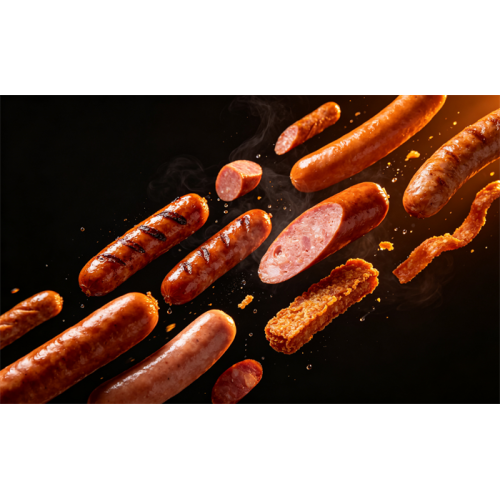
Chicken sausage was used as the research object, and chicken breast meat was used as the main raw material. Fat meat and chicken skin in the conventional formula were eliminated, and the formula was optimized to reduce the fat content of the product to below 3%, aiming to provide formula guidance for the preparation of low-fat and healthy smoked sausages.
1 Materials and methods
1.1 Materials
Chicken breast meat, inulin, konjac gum, phosphate, soy protein isolate, culture medium for microbial test, medium-speed qualitative filter paper, petroleum ether, hydrochloric acid, copper sulfate, potassium sulfate, sodium hydroxide
1.2 Instruments and equipment
TGL-10B desktop centrifuge, AL-204 electronic analytical balance, LT-BIX300M constant temperature and humidity incubator, HB-80L chopper, XND-30 sausage stuffer; ZH-zKJ-500 packaging machine, DHG-9123A drying oven, KDN-812 Kjeldahl nitrogen analyzer.
1.3 Methods
1.3.1 Optimization of chicken sausage formula
(1) Effect of konjac flour and inulin compound ratio on product quality.
On the basis of adding 2% salt and seasoning, 1% soy protein isolate, 0.2% phosphate, 70% chicken breast and 20% ice water, different compound ratios of konjac flour and inulin were added. The total addition of the compound was 6.8%. The compound ratios of konjac flour and inulin were selected as 1:3, 1:4, 1:5, 1:6, 1:7 and 1:8 respectively. Chicken sausage was made after chopping, filling and steaming. The sensory score, water retention and yield were used as evaluation indicators to determine the optimal compound ratio of inulin and konjac flour.
(2) Effect of the addition amount of compound (konjac flour and inulin) on product quality.
Based on the addition of 2% salt and seasoning, 1% soy protein isolate, 0.2% phosphate, 7:2 ratio of chicken breast to ice water, and 1:6 ratio of konjac flour to inulin, the addition of the compound material (inulin, konjac gum) was selected to be 4%, 5%, 6%, 7%, 8%, and 9%, respectively. Chicken sausage was made after chopping, filling, and steaming. The sensory score, water retention, and yield were used as evaluation indicators to determine the optimal addition amount of the compound material (inulin, konjac gum).
(3) The effect of soy protein isolate addition on product quality.
On the basis of adding 2% salt and seasoning, 0.2% phosphate, 7:2 ratio of chicken breast to ice water, 1:6 ratio of konjac flour to inulin, and 6% addition, the addition of soy protein isolate was selected to be 0.5%, 1.0%, 1.5%, 2.0%, 2.5%, 3.0%, respectively. After chopping, filling, and steaming, chicken sausage was made. The sensory score, water retention and yield were used as evaluation indicators to determine the optimal addition of soy protein isolate.
(4) Effect of ice water addition on product quality.
On the basis of adding 2% salt and seasoning, 0.2% phosphate, and 6% konjac flour and inulin compound, the addition of ice water was selected to be 10%, 12%, 14%, 16%, 18%, and 20%, respectively. After chopping, filling, and steaming, chicken sausage was made. The sensory score, water retention and yield were used as evaluation indicators to determine the optimal addition of ice water.
(5) Determination of the optimal formula of low-fat chicken sausage.
In order to obtain the best formula of low-fat chicken sausage, sensory score, water retention and yield were used as evaluation indicators, and the L9 (34) orthogonal test was used to determine the formula, and the parallel test was repeated 3 times.
1.3.2 Processing flow and key points of chicken breakfast sausage
The processing flow of chicken breakfast sausage: chicken breast → pretreatment → chopping → filling → steaming → packaging → cooling.
Key points of operation: Select fresh chicken breast without skin after slaughter and not frozen, use within 24 hours, remove visible fat from the chicken breast, control the temperature of the chopping process below 10℃, ensure that the length of each sausage section is 9-10 cm, the diameter of the sausage body is 2 cm, the steaming temperature is 90℃, the steaming time is 25 min, and the product passes through a rapid cooling tunnel after steaming to reduce the core temperature to below 4℃ within 20 min.
1.3.3 Index determination
(1) Sensory scoring
Blind scoring was used, and professional sensory assessors conducted sensory scoring on the flavor, color, texture, taste and overall acceptability of chicken sausages made with different recipes and processes. After the steamed chicken sausages were cooled to room temperature, they were cut into cubes (1 cm×1 cm×1 cm) and subjected to sensory evaluation using the palatability scoring method. A sensory evaluation panel consisting of 10 people developed a sensory scoring table based on the sensory evaluation specifications for meat and meat products for scoring.
(2) Water retention determination
Refer to the method of Mittal and Barbut with slight modifications. Accurately weigh about 5 g of chicken sausage, wrap it tightly with medium-speed qualitative filter paper, and place it in a 50 mL centrifuge tube. Note that a layer of absorbent cotton should be placed in the bottom of the centrifuge tube in advance. Place it in a centrifuge and centrifuge it at a speed of 4800 r/rain for 8 min. Weigh the mass of the chicken sausage sample after centrifugation, and calculate WHC as the percentage of the mass loss to the original mass.
(3) Yield determination
Referring to Whiting's method, take about 100 g of raw chicken sausage after filling, weigh it accurately, put the sample into a plastic bag, expel the air and tie it up, cook it at a certain temperature for a certain time, cool it to room temperature after cooking, gently wipe the gravy on the surface of the sample with filter paper, and then weigh the sample again. The cooking loss is calculated as the percentage of the weight difference before and after cooking of the chicken sausage to the weight before cooking.
(4) Shelf life test
The steamed chicken sausage is vacuum packed and placed in a constant temperature and humidity chamber at a temperature of 10°C and a humidity of 70%. The total colony count, coliform group, Staphylococcus aureus, Salmonella, and Listeria monocytogenes are tested every day. The sensory changes such as water discharge and color change of the product are observed, and the taste and mouthfeel changes are tasted. The total colony count was determined according to GB 4789.2-2016, the coliform bacteria was determined according to the plate method of GB 4789.3-2016, the Staphylococcus aureus was determined according to the plate method of GB 4789.10-2016, the Salmonella was determined according to GB 4789.4-2016, and the Listeria monocytogenes was determined according to GB 4789.30-2016.
(5) Fat content detection
The fat content in low-fat chicken sausage was determined by Soxhlet extraction method.
(6) Protein content detection
The protein content in low-fat chicken sausage was determined by Kjeldahl nitrogen determination method.
(7) Moisture content detection
The moisture content in low-fat chicken sausage was determined by direct drying method.
2 Conclusion
The addition amount of each component of the low-fat chicken sausage processing formula determined by formula optimization is 72.3% chicken breast, 18% ice water, 6% compound material (konjac powder and inulin mixed in a ratio of 1:7), 1.5% soy protein isolate, 1.5% salt, 0.5% seasoning, and 0.2% phosphate. Formula optimization can significantly reduce the fat content of chicken sausage, achieving the expected goal of <3%, while increasing the nutrient content, improving quality characteristics, and extending the shelf life of the product. The optimization study of the low-fat chicken sausage formula provides a technical reference for the development of other low-fat smoked and cooked sausages.



 Helper Machinery Group Co., Ltd.