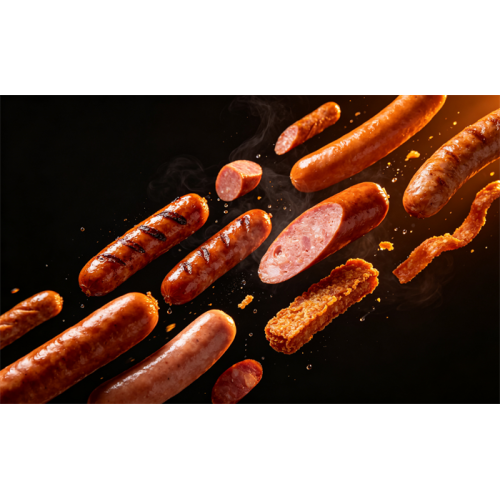
The essence of smoking is the process of absorbing the decomposition products of the wood by the product, therefore, the decomposition products of the wood are the key to determine the effect of smoking. There are many components such as volatile oils, fatty acids, ethanol, etc. known as extractives of wood, which not only accelerate the achievement of the smoking requirements of the products, but also prevent the propagation of microorganisms.
Smoking has the following characteristics
(1) endowed products with a special smoky flavor, due to the high temperature of the products locally, so that the surface of the paste scorched to produce a paste flavor, causing people's appetite;
(2) Prevent the oxidation of fat, which is the smoke components penetrate into the internal role of the meat;
(3) smoke components contained in the aldehydes and phenols of polymerization, the formation of smoked products on the surface of the tea-brown glossy and dry film, not only to get a better color and lustre of the product but also to increase the preservation of products;
(4) for the addition of nitrate cured meat, after smoking and drying, to promote the color red, and remove excessive moisture on the surface of the product, while making the product moderate contraction, giving the product a good texture;
(5) When the temperature of the smoked smoke is above 45℃, it can prevent the reproduction of microorganisms, and when the meat temperature is about 15℃, it can promote the action of meat autolytic enzymes, thus making the product texture soft;
(6) Smoked products can significantly increase the role of enzymes in the internal tissues of the product, and play a role in dehydrating and drying the product and the purpose of thermal processing, the formation of the product's color, aroma, taste, type and so on have a very important role.
Smoking process
1. Pre-smoking treatment
The main purpose of pre-treatment process is to ensure that all the products to be processed in the smoking, cooking before the product surface condition is consistent. However, it is not possible to keep the same time when the products are exposed in the dry environment and the time when they are put into the oven, which results in the inconsistent surface color of the products.
The solution is to spray the product for a short period of time before entering the oven; another method is to maintain a warm, high-temperature environment so that products at low temperatures form a uniform and consistent thin surface layer. At present, when using the smoker production, the equipment with some control programs, the essence is also drying, but to control the humidity, the purpose is also to promote the product color, so that the surface color is consistent. Generally you can set the temperature at 50~60℃ and humidity at 85% to 95%.
2. pre-drying
The purpose of drying is on the one hand to ensure the consistency of the degree of dryness of the surface of the product to prevent the surface from dripping, so that when the product is smoked, the surface to achieve a uniform smoked color. On the other hand, it can also promote the color of the product, if you need a deeper smoke color, the drying time should be shortened, but the drying time is not enough, the moisture on the surface of the product is too large, which will lead to the product is dark brown, or even black consequences. On the contrary, if the drying time is prolonged, the product will be yellow or brownish red.
The temperature setting and time setting of the drying step depends on the type of product, generally the temperature is set at 50-70℃ and the relative humidity is 30% or less. Wet surfaces absorb more smoke than dry surfaces. If a darker color is desired, the pre-drying process must be shortened. If a lighter surface color is desired, the pre-drying process must be lengthened. If the meat product is cooked horizontally in the oven, extending the pre-drying process will minimize the chance of both colors appearing. If the product is over-dried during this process, the color will become too light.
3. Smoking
Common smoking methods in meat processing according to the processing temperature can be divided into cold smoking, warm smoking, hot smoking. Cold smoking, the temperature range of 15-25 ℃; warm smoking, the temperature range of 30-50 ℃; hot smoking, the temperature range of 50-80 ℃; 80 ℃ or more is known as baking smoke. The color of hot-smoked products is obviously better than cold-smoked, but when hot-smoked due to the high temperature, muscle protein will produce thermal denaturation, fat dissolution, quality changes.
The raw materials will be salted for a period of time, to the salting solution of the Baume degrees of 18-20, de-indigo treatment, and then seasoned impregnation, in the temperature range of 15-30 ℃ for 1-3 weeks of smoking and drying, this method of smoking is known as cold smoking method. Cold smoked products produced by the cold smoking method have better storability.
Warm smoking method is the raw material is added with salt in the flavored liquid, for a few minutes or hours of short-term flavored impregnation, and then in the smoking room with a temperature of 30-50 ℃ for a few hours to a few days of smoking and drying, this method of smoking is called warm smoking method.
For non-heated high-grade products often use cold smoking, some products need to be cold smoked for half a day or several days. The use of warm smoking method is conducive to improving the preservation of products, conducive to the formation of specific, useful flora. Generally in the smoking process requires a dry bulb temperature of 50 a 75 ° C, wet bulb temperature 0-55 ° C (relative humidity 30% a 60%).
When liquid smoking is used in a roaster, the roaster is usually turned off and the liquid is atomized and sprayed into the oven. The liquid smoking step usually consists of an atomization phase of the smoke, followed by a short “break” before the oven is restarted and smoking continues. No matter how long the atomization time is, the rest period should not exceed five to ten minutes. Even if the actual atomization time is the same, it is usually more efficient to smoke the atomized liquid in two steps rather than just one longer step. For example, a 20-min drying in between two 15-min liquid smoking processes will be more effective than only a 30-min smoking.
4. Coloring and color fixation
Coloring is to set the smoking color before steaming and finishing at higher humidity. In this step, dry heat conditions are used to promote the formation and stabilization of the desired color. The temperature of the wet sensor should be set at 0°C in this step to open the valve and create dry conditions to promote the formation and stabilization of the smoked color. The coloring step should be long enough to allow for the formation of the same smoked color as set.
Color fixation is a process where the product surface needs to have a consistent smoked color before proceeding to the hot process with higher humidity, and a warm and dry environment is beneficial in promoting smoked color stability during this step of the process. Generally, the dry bulb temperature is set at 60-70°C and the wet bulb at 0-50°C (relative humidity is less than 20%). There are some variations in the actual operation of this process, for example, if the humidity is high during smoking, a short drying time is used, which is conducive to the formation and fixation of the color. After drying, it is best to stay 2-3min before smoke extraction and drying. If the liquid smoking method is used, the color should be fixed immediately after liquid smoking, which is conducive to the stability of the product surface of the smoked liquid color.
5. Cooking
Cooking process is the middle step between the coloring process of low humidity and the end process of high humidity. The wet sensor is set to 60°C in this step to slowly change the properties of surface proteins. Meat proteins change their properties very strongly at 60°C. Typical set points for dry sensors in the cooking step are 70°C to 85°C, and typical set points for wet sensors are 55°C to 65°C.
For some products, this step is not necessary and can be omitted. The maturation process is typically a drying, steaming, and baking procedure in the smoker to bring the product to the desired center temperature. If the product surface smoke color is consistent and stable, the high temperature and high humidity of steam cooking accelerates the process of the Melad reaction as well as the absorption of smoke, which darkens the smoke color of the product after ripening. The dry bulb temperature during cooking is 72~90℃ and the wet bulb temperature is 68-84℃. There are different treatments in the setting of cooking time, one is based on experience in setting the cooking time; the second is based on the center temperature of the product, the general temperature of 68-78 ℃. Steaming time can not be too long or too short, otherwise it will affect the texture and flavor of the product. After cooking, it can be sprayed and cooled or dried again and air-cooled according to the characteristics of the product.




 Helper Machinery Group Co., Ltd.