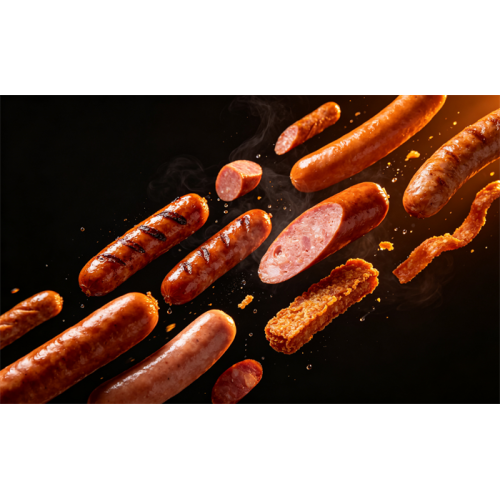
In meat product processing, nitrates (such as sodium nitrate and potassium nitrate) and nitrites (such as sodium nitrite and potassium nitrite) are commonly added for color preservation. However, issues such as excessive usage and residue levels of nitrites have long been one of the focal points of global food safety concerns.
In order to ensure the edible safety of meat products, aiming at the potential safety problems of nitrite, the current development of new color protection technology mainly has the following two directions: first, develop new natural food color protection agent to replace or partially replace nitrite to reduce the use of nitrite, which is mainly composed of chromogenic agent, antioxidant/multivalent chelating agent and bacteriostatic agent; Second, compounds were added at the conventional nitrite concentration to inhibit the formation of harmful substances nitrosamine.
1. common substitutes for nitrite
Natural substances are safe, healthy and environmentally friendly, and are safer food color protectants than nitrite. Natural food can be directly added to meat products for color protection and coloring after simple physical treatment, or natural pigments can be extracted and added to meat products with antioxidants and antimicrobial agents to reduce the use of nitrite. At present, researchers have found some natural foods and pigments with good color effect, such as egg yolk powder, Monascus red pigment and nitrosohemoglobin (HbNO), which can reduce the amount of nitrite in meat products.
1.1 egg yolk powder, a natural food, uses fresh eggs as raw materials and contains a large amount of hydrogen sulfide. Hydrogen sulfide has the same function as nitrite. It can combine with myoglobin to make meat products appear bright red. Yusenyan et al. Found that the optimal ratio of egg yolk powder and sodium nitrite was 10g/kg and 0.01 g/kg, respectively, when adding a certain amount of adjuvants (ascorbic acid 0.05%, α - tocopherol 0.05%, potassium sorbate 0.08%). Celery, as a natural nitrate resource pool, has a nitrate content of 2327~2591mg/kg, which is a natural food color fixative. Research shows that its application effect in color and flavor is better than that of cabbage and other vegetables. In addition, celery is rich in ascorbic acid, which can block the synthesis of nitrosamine to a certain extent. Xiawenyin et al. [6] added 0.2% fermented celery powder to Sichuan sausage, and the sausage was bright red and full in appearance, with good texture characteristics and flavor. The nitrite residue was (1.398 ± 0.043) mg/kg, indicating that adding celery powder can significantly reduce the nitrite residue. In actual production, no chemical synthetic additives are allowed to be added to organic food. The nitrite residue may exceed the standard if only celery powder is used to replace nitrite. It needs to be used in combination with ascorbic acid, nicotinamide, etc., so as to reduce the nitrite residue. In practical application, the acceptability of color and flavor of sausage by consumers must also be considered when adding natural food as color fixative in sausage.
1.2 Monascus pigment is the most mature natural pigment at present. Monascus pigment, which is fermented by filamentous fungi of Monascus, is a natural edible pigment with good stability, especially for protein coloring, and can keep the bright red color of meat products for a long time. Lishanshan et al. [9] found in their research on the application of Monascus pigment instead of nitrite in Sichuan sausage that when the addition amount of Monascus pigment is 0.12g/kg under the condition of dark packaging, or under the condition of transparent packaging, the addition amount of isoascorbic acid is 0.45g/kg; When the red pigment content of Monascus was 0.12 g/kg, the red degree, texture, flavor and other indicators of sausage were close to those of 0.12 g/kg nitrite alone. In addition, the study found that Monascus pigment had good coloring effect, and the combination of Monascus pigment with nisin or potassium sorbate had obvious inhibitory effect on Clostridium botulinum in meat products. Xuhaixiang and others used sodium isoascorbate, Monascus pigment and nisin to replace part of sodium nitrite in sausage. They found that the quality of sausage made with 0.065% sodium isoascorbate, 0.15% Monascus pigment, 0.06% nisin and 40 mg/kg sodium nitrite of raw meat quality was similar to that made with 90 mg/kg sodium nitrite.
Carmine is a natural pigment extracted from the seeds of carmine grown in tropical and subtropical areas. It has good stability and can be used as a food colorant. Zarringhalami s and others added 1% carmine powder to sausage to replace 20%, 40%, 80% and 100% nitrite in sausage, respectively. The results showed that when carmine replaced 60% nitrite content, the color of sausage was the best, and there was no significant difference in antibacterial ability and sensory indexes between sausage and control group.
Lycopene is acidic, can adjust the pH value of meat products, and has certain antioxidant capacity and color effect. Wangjungong et al. Added 1.5 g/kg lycopene to sausage to replace 0.08 g/kg nitrite, and found that new chromogenic substances may be produced, so as to improve the color of sausage. However, the stability of pure lycopene is poor. Researchers focus more on the research and development of meat products with tomato products rich in lycopene, such as tomato powder, tomato paste and tomato peel instead of nitrite. Calvom m et al. Measured the effect of lycopene rich dry tomato peel on the texture and sensory properties of fermented sausage, and found that it not only contributed to the color of sausage, but also inhibited the oxidation of fat; At the same time, as a by-product of tomato, the dried tomato peel can be reused, which saves the cost of lycopene extraction.
Natural pigments are safe and feasible as substitutes for nitrite, but they can not completely replace nitrite. They have their own advantages and disadvantages, and specific conditions and requirements should be considered when using. Various factors will affect the use effect of natural pigment. For example, it has poor stability under natural conditions and is easily affected by temperature, light, pH value and other factors, causing discoloration and fading, which limits its application. Therefore, some protective measures should be taken during use, such as adding ascorbic acid to prevent oxidation and adding metal chelating agent to avoid the influence of metal ions. In addition, when using natural pigments to color meat products, it also needs to be combined with bacteriostatic agents and other color protection additives to achieve better color development and antibacterial effect.
1.3 the color protection technology of nitrosohemoglobin is different from the above natural pigments. Nitrosohemoglobin is prepared by the reaction of livestock and poultry blood hemoglobin and nitrite. As a meat chromogenic agent, it can replace nitrate or nitrite to achieve low nitrate or no nitrate in meat products, and provide consumers with safe and nutritious high-quality meat products. This technology effectively utilizes animal blood by-products, strengthens food with iron and provides high-quality protein. Liu p x et al. [17] found that sausage with 2 g/kg of nitrosohemoglobin had similar redness to sausage with nitrite, and could inhibit fat oxidation and Enterobacter growth, indicating that nitrosohemoglobin has research and development value as a substitute for nitrite. However, under natural conditions, nitrosohemoglobin is sensitive to light and Fe2+, easy to oxidize and discolor, and its stability is not high [18]. Therefore, finding the best application scheme to give full play to the coloring effect of nitrosohemoglobin is an urgent problem to be solved.
2. common nitrosamine synthesis blockers
Nitrite can react with secondary amines in meat to produce carcinogenic and teratogenic nitroso compounds, which have been proved to have strong carcinogenic effect, so blocking the generation of nitrosamines is an effective way to reduce the harm. Therefore, when nitrite and nitrate are used for color protection, reducing substances, such as ascorbic acid and plant polyphenols, are added as color protection additives. The main purpose is to prevent the formation of nitric acid, reduce high valent iron ions to divalent iron ions, prevent myoglobin from being oxidized to high valent myoglobin, promote the combination of nitroso and myoglobin, and thus block the generation of nitrosamines. Guoshasha et al. Added four antioxidants, ascorbic acid, sodium ascorbate, isoascorbic acid and sodium isoascorbate, respectively, during the curing of western style ham, which can significantly reduce the content of nitrosamine and delay fat oxidation. In addition, phenolic compounds can also block the synthesis of nitrosamines by binding with amino compounds in meat.
3. color protection technology by microbial fermentation
Microbial contamination of meat products will cause an increase in oxygen partial pressure. For example, Pseudomonas, Pseudomonas fluorescens, etc. can oxidize red myoglobin to brown high iron myoglobin, which is not conducive to the color of meat products. However, in recent years, studies have found that some microorganisms can improve the color of meat products and make them present beneficial colors. As a new color protection technology for meat products, microbial fermentation has been widely studied abroad. At present, there are two main ways to protect the color: one is that some microorganisms can convert high iron myoglobin into new myoglobin derivatives to achieve the purpose of color development; The second is that microorganisms contain nitrate reductase, nitrite reductase, nitric oxide synthase and other enzymes, which can metabolize to produce natural no to replace the NO produced by nitrate/nitrite reduction, so as to combine with myoglobin to achieve chromogenic replacement of nitrite. At present, domestic research mainly focuses on the second approach, which is also an important direction.
4. summary and Outlook
With the increasing awareness of health, safety and environmental protection, the color protection technology of meat products has developed more rapidly, and more new color protection technologies have been found to have good color protection effects, such as amino acids, nitric oxide, nicotinamide, glucose aldehyde, ethyl maltol and so on. In addition to adding exogenous substances to meat products for color protection, it can also be used in food packaging. For example, the active packaging technology is to protect and improve meat products by using the active substances such as adsorbents, releasers and reactants added in the packaging materials. It can also effectively control the oxygen, moisture, bacteria and other factors in meat products, extend the shelf life of meat products, and achieve the stability of the color of meat products. Finally, in the future, the color protection technology of meat products will pay more and more attention to intelligence and digitization. Through the use of advanced sensors, data acquisition and analysis technology, the temperature, humidity, pH and other factors in the processing of meat products can be more accurately controlled, so as to achieve a more stable and controllable color protection effect. These new technologies will make meat products more healthy, safe and delicious, and meet the new needs and expectations of consumers for food.




 Helper Machinery Group Co., Ltd.