Livestock and poultry meat products are the primary sources from which people obtain animal-based proteins, occupying a significant proportion in people's daily dietary structure. Currently, the livestock and poultry meat products available in the market mainly include fresh meat and various processed cooked meat products. With the increasing living standards and consumption levels of people, the consumption of fresh meat has gradually evolved from traditional hot fresh meat to industrially produced chilled meat that is sliced, preserved, and packaged. Similarly, processed cooked meat products have also transformed from canned goods to Western-style low-temperature meat products packaged mainly with soft plastic composite materials, as well as high-temperature meat products rich in local characteristics, forming a meat product structure system that combines Chinese and Western elements in China.
1.Packaging of Fresh Meat Products
Fresh meat that is directly sold without undergoing cooling and acid removal processes after slaughter is referred to as hot fresh meat. When hot fresh meat is sold, the muscles are in the rigor mortis stage, exhibiting poor water-holding capacity and tenderness, resulting in inferior taste. Moreover, it is often displayed and sold as uncovered meat, making it highly susceptible to microbial growth and spoilage.
In contrast, chilled meat refers to meat from animals that have been slaughtered under strict inspection and quarantine protocols, rapidly cooled to a temperature range of 0-4°C within 24 hours, and then processed, distributed, and retailed under low-temperature conditions. The growth and reproduction of most microorganisms are inhibited in chilled meat, and pathogenic bacteria such as Clostridium botulinum and Staphylococcus aureus are unable to secrete toxins, ensuring the flavor, nutritional value, and safety of the meat. Additionally, chilled meat undergoes a sufficient aging and tenderization process, resulting in a soft and elastic texture, excellent water-holding capacity, and superior tenderness. Therefore, chilled meat has experienced rapid development in China in recent years and has become the trend in meat product development.
For fresh meat products, commonly used materials for modified atmosphere packaging (MAP) include OPP/PE, PET/PE, PVDC/PE, PA/PE, EVAL/PE, etc. Generally, base materials such as Ny/PE and Ny/IONOMER (ionomeric polymer) can also be employed.
The primary packaging method for fresh meat products is shallow tray wrapping: The chilled meat is placed in an opaque or transparent shallow tray made from molded pulp or thermoformed EPS (Expanded Polystyrene) or PS (Polystyrene) sheets. A transparent plastic film is then stretched or shrink-wrapped over the surface. To prevent the paper tray from absorbing meat juices and moisture, which could lead to quality deterioration or water accumulation in the tray, a layer of absorbent paper is often placed at the bottom of the tray. The transparent films commonly used for covering the surface of the shallow tray include the following: glassine/PE, hydrochloric acid rubber film, LDPE (Low-Density Polyethylene), PVC (Polyvinyl Chloride), PP (Polypropylene), and their heat-shrinkable films.
The packaging requirements for fresh meat products, particularly for chilled meat, primarily focus on preservation. To achieve the corresponding quality standards, the packaging should meet the following requirements:
① It should protect the chilled meat from external contamination by microorganisms and other pollutants.
② It should prevent the evaporation of moisture from the chilled meat, maintaining a high relative humidity within the packaging environment to prevent the meat from drying out and dehydrating.
③ The packaging material should have an appropriate gas permeability rate, with an oxygen transmission rate that sustains the minimal cellular activity required to preserve the color of the chilled meat while preventing oxidation and spoilage.
④ The packaging material should block the intrusion of external odors.
2.Frozen Meat Packaging
The frozen meat commonly referred to mainly denotes meat in a frozen state, achieved through artificial or natural conditions, with a deep-layer temperature reaching -10 to -15°C. Under normal circumstances, frozen meat can be preserved for 6 to 12 months, or even longer. The primary purpose of frozen meat packaging is to control quality issues that often arise during refrigerated storage, namely weight loss due to drying (freezer burn), fat oxidation, and color changes.
Similar to fresh meat, frozen meat also undergoes color changes during storage, starting from the surface and gradually progressing inward. The color of the meat transforms from the bright red of oxyhemoglobin to the brown of oxidized myoglobin. This change is closely related to temperature, with higher temperatures accelerating the process. For instance, it takes 7 days at -5°C, 14 days at -10°C, and 56 days at -20°C for the color change to occur.
Packaging Materials for Frozen Meat
Commonly used packaging materials for frozen meat include PE, PP, PET, PA, as well as various composite materials such as PET/PE/aluminum foil/PE and PA/PE.
Packaging Methods for Frozen Meat
The commonly employed packaging methods for frozen meat include shrink wrapping, gas flushing packaging, and vacuum packaging. Shrink wrapping is characterized by a smooth product appearance, clear visibility of the meat, and low cost. Gas flushing packaging, by introducing gases such as CO2 and N2, prevents fat oxidation and microbial activity in the meat. Vacuum packaging removes air from the bag, and the reduction in oxygen similarly inhibits bacterial growth and fat oxidation. Additionally, the packaging material adheres closely to the surface of the meat, effectively reducing weight loss due to drying in frozen meat.
Packaging Requirements for Frozen Meat
Packaging materials for frozen meat should meet the following conditions:
① Strong low-temperature resistance, maintaining flexibility even at -30°C;
② Low gas permeability to meet the needs of oxygen isolation and adapt to gas flushing or vacuum packaging;
③ Low water vapor transmission rate to minimize weight loss due to drying in frozen meat.
3.Packaging Materials for Cooked Meat Products
Commonly used packaging materials for cooked meat products include: smooth glassine paper, plastic-coated glassine paper, polyethylene (PE), polypropylene (PP), polyvinyl chloride (PVC), polyvinylidene chloride (PVDC), aluminum foil, and composite films such as glassine/PE, polyester/PVDC/PE, and glassine/PVDC/PE.
Packaging Methods for Cooked Meat Products
In addition to canning, common packaging methods for processed meats include film wrapping, vacuum gas flushing packaging, and heat-shrink packaging.
4.Packaging of Chinese-Style Meat Products
Many Chinese-style meat products require high-temperature (121°C) sterilization after packaging, necessitating packaging materials that can withstand sterilization temperatures above 121°C. Commonly used materials include PA (PET)/CPP, EVAL/CPP, and PA (PET)/Aluminum foil/CPP. These products are typically vacuum-packaged and then sterilized at high temperatures, achieving a shelf life of up to 6 months, often referred to as soft cans.
The main deterioration modes of Chinese-style dried meat products include moisture absorption and mold growth, fat oxidation, and flavor changes. The primary packaging requirements are oxygen and moisture barrier properties. Suitable materials include BOPP/PA (PET)/PE, BOPP/PVA/PE, and FT/PE. To prevent significant damage from light exposure, aluminum-plated PA (BOPP)/PE and BOPP/Aluminum foil/PE packaging are commonly used, along with nitrogen gas flushing packaging.
5.Packaging of Western-Style Meat Products
Some Western-style meat products are heat-treated at around 90°C after filling. To ensure product compactness, packaging materials with heat-shrink properties are generally required, such as PA, PET, and PVDC shrink films. Some Western-style meat products are not subjected to high-temperature sterilization after production. They can be packaged in opaque or transparent shallow trays made from thermoformed PE or PS sheets, with a transparent plastic film stretched over the surface, or packaged using PA, PVC, and other shrink films for heat-shrink packaging. These products have a shorter shelf life and require circulation at low temperatures of 4-6°C.
6.Packaging of Sausage Products
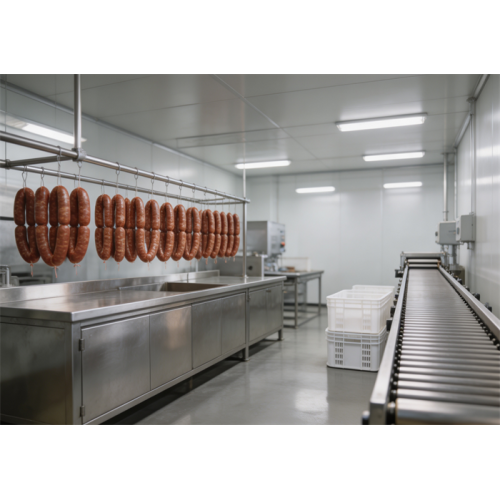
Sausage products are an important category with unique packaging requirements. They need to be shaped and packaged using casings. The packaging methods mainly include regular filling packaging and vacuum filling packaging.
Casings are disposable packaging materials that come into direct contact with the meat filling in sausage products. The shape, hygiene quality, preservation performance, circulation performance, and commercial value of sausage products are directly related to the type and quality of the casing. Each type of casing has its unique properties. When selecting casings, considerations should be given to their edibility, safety, permeability, shrinkability, adhesiveness, sealability, openability, aging resistance, oil resistance, water resistance, heat resistance, cold resistance, and strength, based on product requirements.
7.Packaging Requirements for Cooked Meat Products
The selection of packaging methods and materials for processed cooked meats should meet the specific packaging requirements of various products and ensure a certain shelf life. Considering the common characteristics of processed cooked meat products, the requirements for packaging materials include:
(1) Good oxygen barrier properties to prevent oxygen penetration and oxidation, which can adversely affect the meat products.
(2) High moisture barrier properties to avoid moisture loss from the products or moisture absorption from the environment, leading to quality changes.
(3) Light barrier properties to maintain the quality of meat products by preventing light transmission.
(4) Good adaptability to processing and packaging techniques, with the ability to withstand high-temperature sterilization and low-temperature storage.



 Helper Machinery Group Co., Ltd.