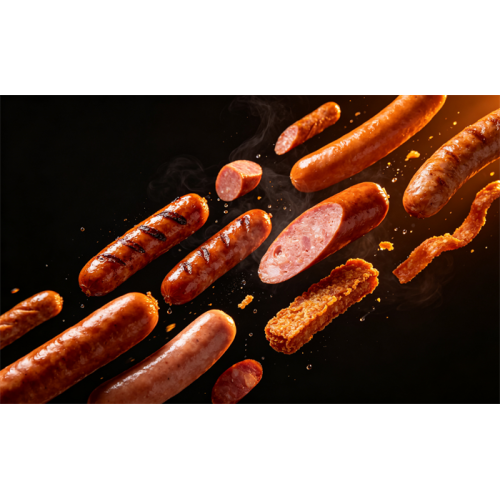
Sausage is made of fresh pork as the main raw material, supplemented by salt, spices and other condiments, through meat cutting, pickling, sausage, drying, cooking and packaging. Its taste is mellow, the meat is compact, and the color is red and bright, which is deeply loved by consumers. However, with the continuous improvement of consumers' requirements for food quality, the traditional processing technology gradually shows some limitations, especially in the key links such as pickling, drying, cooking and packaging, which have the problems of long production cycle, poor palatability and high salt content.
Therefore, the introduction of modern meat processing technology in sausage production and the improvement of product quality are of great significance to promote the development of sausage industry. This paper discusses the characteristics of modern meat processing technology and the feasibility of its application in sausage production, in order to provide a theoretical basis for the industrialized production of sausage.
1、 Modern meat processing technology
Modern meat processing covers cutting, pickling, smoking, drying, cooking, packaging and other processes. Advanced meat processing technologies such as vacuum kneading and pickling, low salt pickling, vacuum drying, vacuum low temperature cooking, vacuum packaging and modified atmosphere packaging are also increasingly applied to traditional meat processing.
These processing technologies have high production efficiency and good controllability, which can effectively inhibit the oxidation of fat in meat and the growth and reproduction of microorganisms, thus improving many problems existing in the traditional processing technology, such as susceptible to weather, long production cycle, unstable quality and high salt content of products. By using modern meat processing technology, it can not only improve the quality, safety and extend the shelf life of meat products, but also retain its nutritional value to the maximum extent, meet the diversified needs of consumers, and then improve the economic benefits of enterprises.
2、 Application feasibility of modern meat processing technology in sausage production
1. modern pickling technology
(1) Vacuum rolling salting
In the processing of modern meat products, the commonly used curing technologies include injection curing, vacuum rolling curing, ultrasonic curing, etc. Among them, vacuum rolling curing is favored because of its high efficiency and wide application. The process uses negative pressure and mechanical action to make the raw meat continuously collide with the kneader, producing extrusion force and friction force, tearing muscle fibers and breaking muscle cells, so as to make the pickling solution penetrate evenly, significantly improve the pickling efficiency, accelerate protein dissolution, and improve the flavor, texture and water retention of meat products.
In addition, vacuum rolling curing can effectively isolate oxygen and maintain a moderate low temperature, thus reducing the risk of browning and corruption of raw meat. The results showed that the hardness of Laiwu sausage cured for 6 hours under the conditions of 0~4 ℃, rotating speed of 10 R · min-1 and vacuum degree of -0.08 MPa was significantly reduced and the elasticity was improved compared with the sausage produced by the traditional method.
(2) Low salt pickling
Salt plays an important role in meat processing, which can improve the color, water holding capacity, fat adhesion and flavor of meat products, and reduce water activity to extend the shelf life. The salt content of sausage is high. For example, the salt content of Laiwu sausage is 9% -10%, so the shelf life is long. However, excessive intake of salt may lead to kidney damage, hypertension and other problems, posing a threat to the health of consumers.
At present, there are two main methods to reduce the salt content in meat products. ① Reduce the amount of salt added. Mo Tongtong et al. Successfully controlled the salt addition to 2.2%, which was only 33% of the salt content of traditional sauce beef, and improved the color, shear force and texture properties of sauce beef by using the low salt treatment method of liquor and salt. ② Salt is partially replaced by salty alternatives. The research shows that potassium chloride, calcium chloride and magnesium chloride have salty taste and can partly replace sodium chloride. Among them, potassium chloride and sodium chloride have similar properties and are often used as substitutes for table salt, but excessive addition will affect the texture properties of meat products. The research showed that the maximum acceptable replacement amount of Laiwu sausage made by partially replacing sodium chloride with potassium chloride was 45%, which reduced the sodium ion content in the sausage by about 47.4%, and the key indicators of the product such as flavor, hardness, elasticity and shelf life were not significantly affected. Niuchaojie successfully reduced the salt content in the chicken paste flavor by 74.3% by using the compound salt composed of sodium chloride, magnesium chloride and calcium chloride instead of the edible salt in the chicken paste flavor, while maintaining the overall aroma characteristics of the low salt chicken paste flavor basically unchanged.
2. modern drying technology
In recent years, with the continuous development of meat processing equipment and technology in China, new drying technologies such as hot air drying and vacuum drying have been widely used. Among them, hot air drying is subdivided into constant temperature and humidity drying and variable temperature and humidity drying. Fang Xingxing et al. Found that the surface of air dried sausage dried by constant temperature and humidity drying was wrinkled, the taste was hard, and it was difficult to chew; The air dried sausage made by variable temperature and humidity drying has obvious advantages in color, brightness and taste. Compared with hot air drying, vacuum drying has the advantages of fast drying speed and slow down the oxidation of food raw materials, which can well solve the problems caused by hot air drying.
Yang boruo et al. Showed that under the same conditions, the vacuum drying time was 8.06 hours shorter than the hot air drying, and the sausage made by vacuum drying was significantly better than the traditional drying process in terms of color, oxidation degree and overall acceptance. Because the high temperature and humidity environment in summer is not conducive to the quality maintenance of air dried sausages, the production of sausages is usually concentrated in spring, autumn and winter, which cannot achieve continuous production throughout the year. The introduction of variable temperature and humidity drying or vacuum drying can not only improve the drying efficiency and achieve uninterrupted production throughout the year, but also effectively reduce the oxidation degree of fat in sausage, improve its color, flavor and taste, and enhance the market competitiveness of sausage products.
3. modern cooking technology
Vacuum low temperature cooking is a modern meat processing technology. This method is to seal the food in a vacuum bag for water bath cooking, which can alleviate the above problems to a certain extent. Through the synergistic effect of low temperature and vacuum packaging, vacuum low temperature cooking can not only inhibit the oxidation of food and the growth of microorganisms, prolong the shelf life, but also improve the water holding capacity of meat products, improve the texture and flavor of products, which has the advantages of low cost, easy operation and suitable for promotion. The research results in other meat products show that the application of this technology in sausage production is feasible, but it still needs further research and verification in actual production, especially for the key parameters such as cooking temperature and time.
4. modern packaging technology
At present, the preservation methods of meat products mainly include vacuum packaging and modified atmosphere packaging. Vacuum packaging is a technology widely used in the food industry, which can inhibit the growth and reproduction of microorganisms by evacuating the air in the packaging bag to form a vacuum environment. For example, Laiwu sausage is packaged in aseptic vacuum after cooking, with a shelf life of about 180 days. However, vacuum packaging can not effectively inhibit the reproduction of anaerobic bacteria and enzyme activity. Therefore, long-term storage may affect the flavor, color and texture of the product, thereby reducing the quality of the sausage.
Modified atmosphere packaging is to fill N2, CO2, O2 and other gases into the packaging bag after vacuum pumping to adjust the gas composition in the bag, so as to inhibit microbial growth and fat oxidation, extend the shelf life and maintain the flavor and color of food. Dengwanqi, guojingjing and other researchers showed that the modified atmosphere packaging combination of 50% CO2+40% O2+10% N2 could effectively maintain the color value, moisture content and volatile substances of sausage, significantly extend the shelf life of sausage and maintain its flavor quality. Due to the characteristics of the production process, the sausage has low moisture content and high salt content. It can be preserved for about half a year after vacuum packaging, basically meeting the transportation and storage requirements.



 Helper Machinery Group Co., Ltd.